B2B Sales
B2B Sales Playbook: What It Is, Why Your Company Needs One, and How to Build Yours in 2027
A sales playbook turns strong selling practices into consistent team processes. Learn what to include and how Prospecta Clientes helps build yours.
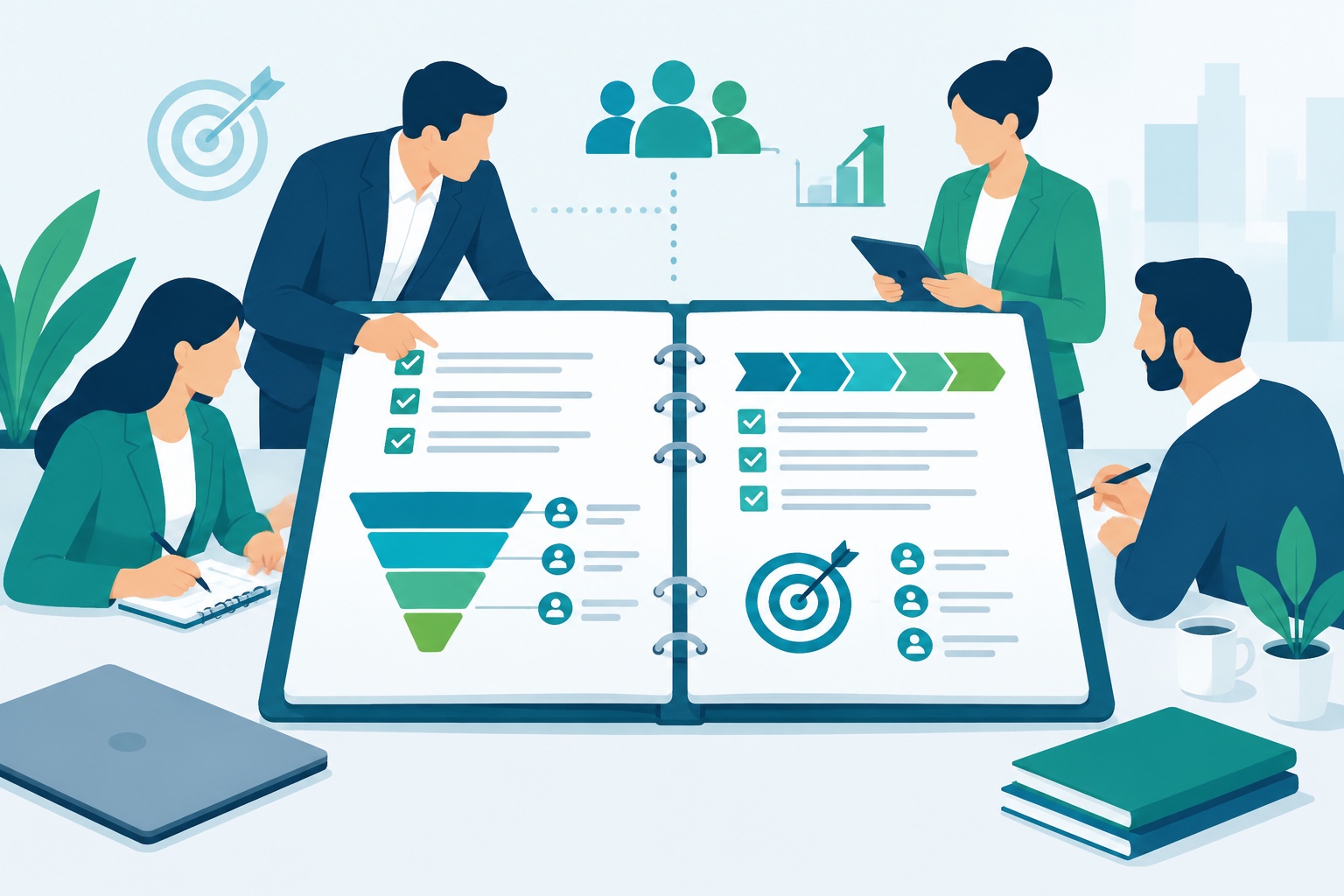
A sales team that depends on individual talent does not scale. When the best seller leaves, some of its knowledge and commercial capacity may leave too.
A sales playbook addresses that dependency: it is a living document recording what works in your sales process so other sellers can learn and apply those practices from their first month.
In this guide, Prospecta Clientes explains what to include and how to build something people actually use, rather than a PDF forgotten in Google Drive.
What Is a Sales Playbook?
It is the sales team's operating manual. It documents:
- Who the ideal customer is, or ICP.
- How to approach each buyer persona.
- Which channels to use at each stage.
- What to say throughout the funnel.
- How to handle common objections.
- Which metrics to track.
- When and how to scale operations.
It should guide decisions, not create bureaucracy. A reduction of up to 50% in ramp-up time can be considered an improvement hypothesis, not a promise. Its effect depends on documentation, training, and the previous process, and must be measured within your business.
Why Most Playbooks Fail
1. They were created once and never updated. The market changed, the ICP evolved, and new tools appeared, but the document still describes an outdated reality.
2. They are too generic. A ready-made template does not incorporate company data, actual prospect objections, or commercial evidence supporting proposals.
3. They were not built with the team. Sellers often ignore instructions disconnected from daily work, particularly when their own practices were not considered.
A good playbook is specific, collaborative, and alive. Review what works and what blocks progress every quarter. Assign an owner to consolidate changes, track versions, and communicate updates. Urgent corrections do not need to wait for the quarterly review.
What a B2B Sales Playbook Should Include
1. ICP and Buyer Personas
Define industry, size, decision-maker role, pain points, and buying timing. A more specific profile makes account prioritization easier.
Illustrative scenario: B2B technology companies with 20 to 200 employees, revenue between R$ 5 million and R$ 50 million, a sales team without structured prospecting, and a VP of Sales or Commercial Director as decision-maker. These figures are segmentation hypotheses, not a universal formula.
Distinguish users, influencers, and financial approvers. Record fit and exclusion signals: no relevant need, an unsupported region, or an incompatible requirement. Validate the profile against real customers rather than assumptions alone.
2. Channels and Cadence
Document when to use LinkedIn, email, WhatsApp, and phone calls, including sequence, touch count, and intervals. Define what happens after no response: a pause, nurturing, or closing the outreach sequence.
Every touch should add context rather than repeat the same request. Respect preferences, opt-out requests, and applicable privacy rules. To structure the sequence, consult the B2B prospecting cadence guide.
3. Scripts and Templates by Stage
Scripts are adaptable references, not lines to memorize. Include initial outreach, follow-up, proposal emails, and cold prospect reactivation, with variations by persona and channel.
Identify fields requiring research: likely problem, account context, and reason for reaching out. A message to sales leadership might address predictability; one to operations might address integration and daily workflows. Both need a clear question and a simple next step.
4. Objections and Responses
Collect the ten most common objections and responses observed by the team. Include “we already have someone handling this internally,” “now is not a good time,” and “I need to consult my business partner.”
For each, record an opening question, a possible response, and wording to avoid. If a prospect mentions an internal team, investigate capacity and gaps before suggesting support. When another decision-maker is involved, agree how to include them without pressuring an early decision.
5. Qualification Process
Establish clear qualification and disqualification criteria. Use BANT, MEDDIC, or another suitable framework, provided everyone understands and applies its criteria consistently.
Check need, impact, investment capacity, decision participants, and timing. Distinguish confirmed information from assumptions. An opportunity should advance when sufficient evidence and an agreed next step exist. No immediate budget may call for nurturing rather than permanent rejection. Record unknowns so the next seller knows what still requires validation.
6. Metrics and Targets
Track prospecting volume, responses, booked meetings, opened opportunities, and stage conversion weekly and monthly. Use realistic references matching your market, deal size, and sales maturity.
Define each rate's denominator to avoid misleading comparisons. Separate booked meetings from attended meetings. Analyze loss reasons and cycle length too. Activity targets help, but do not replace qualification quality or actual progress. Compare cohorts over consistent periods before changing targets or declaring a tactic successful.
7. Tools and Workflows
Explain how to use the CRM, log activities, and select resources for enrichment, cadence execution, and call transcription. Include screenshots and step-by-step instructions where they make tasks easier.
Operations should work as an integrated ecosystem of different platforms, with clear responsibilities. Specify mandatory data, the official record location, and duplicate prevention. To connect this workflow to account acquisition, read the complete B2B customer prospecting guide.
How to Build the Playbook in 5 Weeks
Week 1: interview top sellers and identify meaningful differences. Gather messages that start conversations, useful approaches, and objection responses. Review lost deals as well, so the document captures more than successes.
Week 2: structure the ICP using real data. Compare customers who pay more, stay longer, and refer others. Check whether the pattern supports sustainable delivery, without confusing high revenue with strong fit.
Week 3: document the process through closing. Specify stages, owners, progression criteria, and required information. Include the prospecting-to-sales handoff to prevent meetings without context. Make clear who confirms attendance and supplies discovery notes.
Week 4: build scripts, templates, and responses with the team, not merely for it. Test variations in comparable groups and record learning without automatically attributing small differences to messaging.
Week 5: review and test with a new seller. Ask them to find guidance and complete a task without help. Fix confusing instructions, establish quarterly reviews, and agree on recurring training. Keep the first version manageable enough to use during live work.
The Role of AI in Building the Playbook
AI does not replace the process, but can accelerate tasks:
- Analyze transcripts and identify objection patterns.
- Generate script variations for testing.
- Draft emails tailored to buyer personas.
- Support updates using recent metrics.
Prospecta Clientes uses AI to support speed, accuracy, and alignment with customer reality. Suggestions require human review. Protect sensitive information, check interpretations, and do not turn an isolated comment into a sales rule. Approve changes before publishing them for the whole team.
How Prospecta Helps Build Your Playbook
Starting from scratch requires time, methodology, and judgment to separate useful practices from noise. Prospecta Clientes works alongside customers on diagnosis, collaborative development, tool implementation, and monitoring during the first weeks.
The aim is greater sales consistency and less dependence on individual performance. Adoption should show up in daily work: consultation during negotiations, complete records, and data-driven review meetings.
Want a playbook aligned with your company? Prospecta Clientes combines methodology, AI, and support with your team. Schedule a free conversation to discuss your current process and next steps.
FAQ
What is a sales playbook?
It is the sales team's operating manual, documenting ICP, channels, scripts, objections, and metrics to reduce dependence on individual talent.
How long does it take to create one?
Typically 4 to 6 weeks with a clear methodology and team commitment. Prospecta Clientes' accumulated experience can help accelerate the process, depending on scope and participant availability.
Does it work for small companies?
Yes. With 2 or 3 sellers, losing one person can be critical. A playbook helps keep knowledge within the company and makes training easier.
How often should the playbook be updated?
Review it quarterly using funnel data and team feedback. Update it sooner when the ICP, offering, tools, or sales process changes significantly.
Want to apply this in your operation?
Prospecta combines LinkedIn, multichannel automations, CRM and human SDRs to generate qualified meetings every day.
Keep reading
B2B Prospecting
Prospecção de Clientes B2B: o Guia Completo para Gerar Leads em 2026
O guia definitivo de prospecção B2B em 2026: canais, processo, ferramentas, automação, métricas, erros comuns e FAQ para gerar leads qualificados todos os dias.
B2B Prospecting
Cadência de prospecção B2B: estrutura, exemplos e templates que convertem
Como montar uma cadência de prospecção B2B com LinkedIn, e-mail e WhatsApp. Estruturas testadas, templates de mensagens e métricas de referência.