AI for Sales
How to Use AI in the B2B Sales Process: From Prospect to Close
See where AI already replaces manual work in B2B sales, which tools work, what still needs people and how to get started.
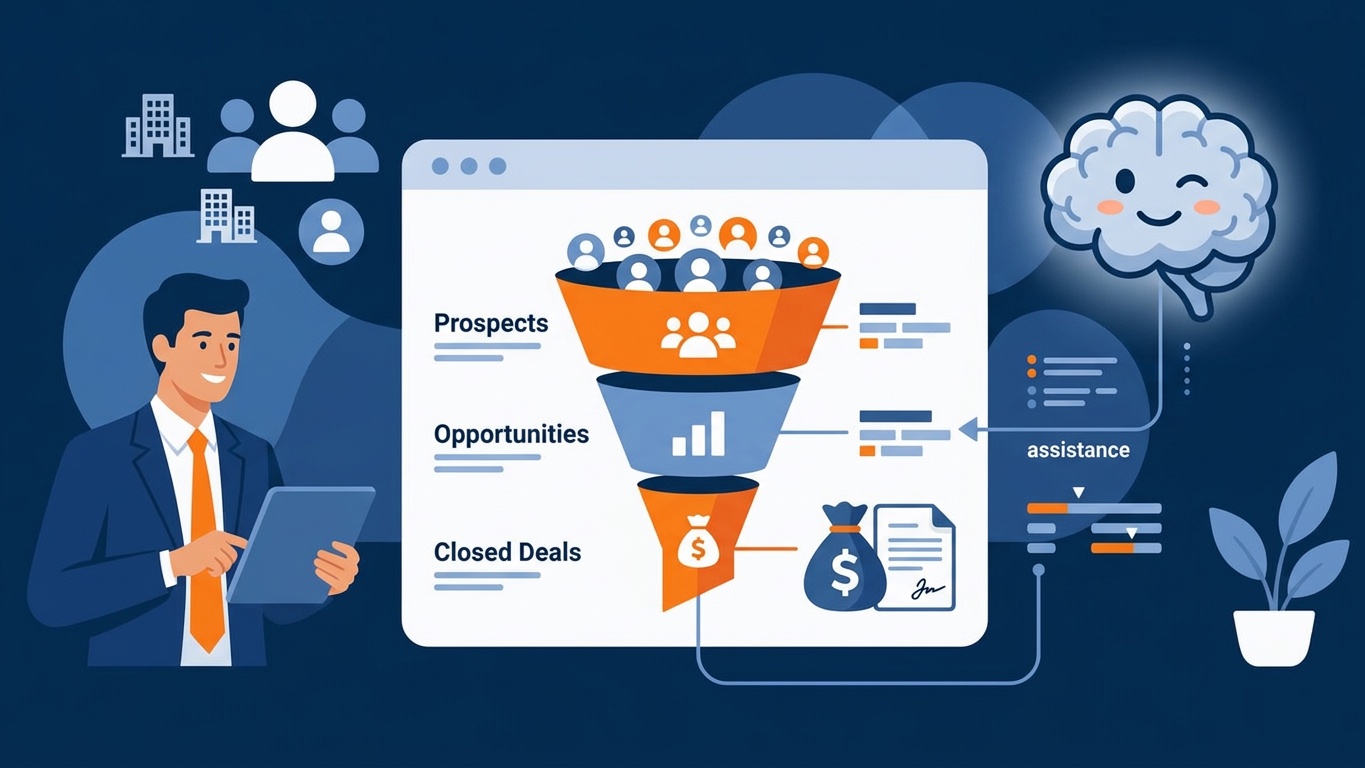
AI is already in your sales process, even if you haven't noticed
Many people still talk about artificial intelligence in sales as something for the future. In practice, it's already part of the daily routine of B2B sales teams: in the CRM, in email, on LinkedIn, in meeting recordings.
The question is no longer "whether" to use AI in the B2B sales process, but where it creates real gains and where it still gets in the way.
In this guide, we walk through the process from prospect to close, show where AI already replaces manual work, what still needs people and how to start without disrupting your operation.
Where AI already replaces manual sales work
Research and data enrichment
An SDR used to spend hours opening websites, LinkedIn profiles and news articles to understand a company. Today, AI tools do that enrichment in seconds: industry, size, technologies used, recent hires, relevant news.
The gain isn't just time. It's context. Outreach that references a real move by the company is far more likely to get a reply than a generic message.
List building and segmentation
AI helps identify which accounts look like your best customers. With a well-defined ICP, it combines data and suggests companies and roles with higher conversion potential.
Writing messages and copy
Drafting a cold email, a LinkedIn message or a follow-up is no longer a bottleneck. AI generates variations, adapts the tone to the role and personalizes based on enriched data.
The caveat is not to outsource the thinking. AI writes fast, but the team defines the core message, the value proposition and the boundaries.
Lead qualification
AI models can classify replies ("interested", "not now", "not me"), prioritize leads with stronger buying signals and suggest the next step. That keeps SDRs from spending energy on cold contacts while hot opportunities wait.
Call summaries and CRM updates
Recording meetings and automatically getting a summary with pains, objections, next steps and stakeholders is already reality. Even better when that summary goes straight into the CRM, with nobody typing.
This may be the most underrated gain: an up-to-date CRM changes the quality of sales management.
Pipeline forecasting and analysis
AI spots stalled deals, loss patterns and opportunities most likely to close. Managers no longer rely on gut feeling alone for forecasts.
AI tools that work in B2B sales
The market moves fast, so think in categories rather than trendy brands:
- Generative AI assistants (ChatGPT, Gemini, Claude): research, drafts, scripts and meeting prep.
- Data enrichment tools: complete company and contact information.
- Multichannel automation platforms: organize cadences across LinkedIn, email and WhatsApp, with AI personalization.
- CRMs with built-in AI: summarize interactions, suggest next steps and flag risks.
- Meeting recorders and analyzers: transcribe, summarize and extract insights from conversations.
More important than the tool is the integration. Five disconnected tools create more work, not less.
To go deeper on structuring automations, read our article on sales automation with AI and the multichannel cadence guide.
What still needs people
This is where many companies get it wrong: believing AI replaces the salesperson.
It doesn't. It frees salespeople for what only they do well.
Building trust
B2B sales involve risk. Buyers need to trust whoever is on the other side. That's built through listening, empathy and consistency over time.
Leading complex conversations
A good discovery meeting requires the right questions, reading context and the ability to change course. AI can suggest questions, but a person leads the conversation.
Negotiating and handling objections
Every negotiation has political, financial and emotional nuances. This is where a salesperson's experience makes the difference.
Making strategic decisions
Defining the ICP, positioning, account priorities and the ethical limits of outreach remains the responsibility of the team and leadership.
AI from prospect to close: a practical flow
Here's how a well-designed process combines AI and people at each stage:
- ICP definition: the team decides; AI analyzes the customer base and suggests patterns.
- Account list: AI finds and enriches; the SDR validates.
- Messages: AI drafts variations; the SDR adjusts and approves.
- Cadence: automation runs at the right times; the SDR replies personally.
- Qualification: AI classifies and prioritizes; the SDR talks and truly qualifies.
- Meeting: the salesperson leads; AI records, summarizes and updates the CRM.
- Proposal and negotiation: the salesperson leads; AI helps prepare materials and assess risks.
- Close and post-sale: people own the relationship; AI tracks expansion or churn signals.
Risks of using AI in sales without judgment
AI amplifies what already exists. If the process is good, it speeds it up. If the process is bad, it spreads the problem at scale.
The most common risks are messages that sound robotic, outdated data treated as fact, excessive outreach volume and sensitive information entered into tools without care for data protection.
The practical rule is simple: everything that reaches the customer goes through human review, and every piece of personal data follows the company's privacy policy.
How to start using AI in your sales process
Don't start by buying tools. Start with the bottleneck.
1. Find where the team loses the most time
Account research? Writing messages? Updating the CRM? Pick just one.
2. Run a 30-day pilot
Apply AI at that point with a small group, compare it with the current process and measure: time saved, reply rate, meetings booked.
3. Create standards
Document prompts, message templates and review rules. Without standards, everyone uses AI differently and quality fluctuates.
4. Integrate with the CRM
The real gain shows up when data flows between tools without rework.
5. Protect your reputation
Automation without judgment burns lists and brands. Respect LinkedIn and WhatsApp policies, personalize for real and keep volumes healthy. Our article on why your prospecting isn't working covers the most common mistakes.
How to measure the impact of AI on sales
If you can't measure it, you can't tell whether AI is helping or just adding noise. Before and after any change, track a few simple indicators:
- Time spent per account on research and writing.
- Reply rate and positive reply rate by channel.
- Meetings booked per SDR per week.
- Share of CRM records updated after each meeting.
Compare these numbers over at least a month. Real gains show up as more meetings with the same effort, not just as more messages sent.
How Prospecta already uses AI in its prospecting operation
At Prospecta, AI is part of the operation from research to follow-up, always with people in charge.
- Account enrichment and segmentation based on each client's ICP.
- Message personalization for LinkedIn, email and WhatsApp, reviewed by the team.
- Reply classification so SDRs focus on people who showed interest.
- Organized CRM records, with the history of every interaction.
In SDR as a Service, our SDRs use these tools to book more qualified meetings with less manual effort. AI accelerates; the SDR talks, qualifies and schedules.
If you're deciding whether to build or outsource this operation, read SDR as a Service: what it is and how it works.
Next step
Want to see in practice how AI, multichannel automation and SDRs work together to book meetings every day?
Book a demo and we'll show you how it would work in your sales process.
FAQ
Can AI replace the SDR?
No. AI takes over repetitive tasks such as research, drafts and reply classification, but building trust, leading conversations and truly qualifying leads remain the SDR job. Combining both books more meetings.
Which AI tools should I use in B2B sales?
Generative AI assistants, data enrichment tools, multichannel automation platforms, CRMs with built-in AI and meeting recorders. More important than the tool is how well they integrate.
How do I start using AI in my sales process?
Pick the team biggest bottleneck, run a 30-day pilot with a small group, measure time saved and meetings booked, document standards and integrate the data with the CRM before scaling.
What are the risks of using AI in sales?
Robotic messages, outdated data, excessive outreach volume and careless handling of personal data. Human review and respect for data protection and LinkedIn and WhatsApp policies reduce these risks.
Want to apply this in your operation?
Prospecta combines LinkedIn, multichannel automations, CRM and human SDRs to generate qualified meetings every day.
Keep reading

SDR
SDR as a Service: O Que É, Como Funciona e Por Que Está Substituindo o SDR Interno
SDR as a Service: entenda como funciona terceirizar prospecção B2B, vantagens sobre SDR interno e quando vale a pena para sua empresa.
Sales Automation
Cadência Multicanal: como combinar LinkedIn, E-mail e WhatsApp em vendas B2B
Como montar uma cadência multicanal de prospecção B2B com LinkedIn, e-mail e WhatsApp: ordem ideal dos toques, templates e métricas de referência.

AI for Sales
Automação comercial com IA: o que já funciona em vendas B2B
Onde a inteligência artificial realmente acelera vendas B2B: enriquecimento, copy, qualificação, resumo de calls e priorização de leads.